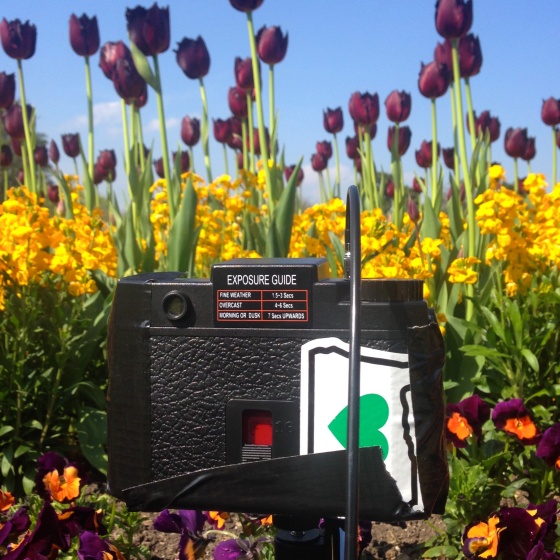
I discovered this evening just how easy it is to jeopardise a marriage. It is possible to do something so heartless, so thoughtless and insensitive that the results of one action can have far reaching consequences. I will freely admit that for the last few weeks I may have been a little overly focused on my hobby. Specifically, I have become obsessed with making and using a pinhole camera. This obsession came to a heated conclusion this evening ending in a confrontation with my wife and as I type this I am literally in the dog house.
A few months ago I was link hopping around WordPress and I stumbled on the pages of an artist called Christian Harkness, He produces the most wonderful images with pinhole cameras. I had seen pictures made with these cameras before but there was something so beautiful about his work that I was inspired to try this for myself. I am amazed when I make an image with a normal camera – so I was looking forward to this strange new challenge. The hope was that by going back to the very beginnings of photography and making my own camera obscura I might learn something. I visited a number of online resources to get a bit of insight and instruction and discovered a whole fascinating world of lensless photography.
I really wanted to try and make my camera using only items that I already had at my disposal. Without looking too hard I was able to cobble together the items needed. My search was aided by our house policy of never trowing anything out. Suddenly the reason for keeping every pin that was ever removed from a new shirt made perfect sense. We own our fair share of geegaws and gimcracks so within ten minutes I had everything assembled.
My setup is pretty basic – it’s a small tin with a pinhole in it. I use Ilford photographic paper to capture a negative image and I then develop the paper in the same tank I use for my normal films. Anything that resembles an image can be scanned and the negative inverted producing a positive. I use a great free internet program called GIMP. I am reliably informed that when software engineers design a piece of programming there is generally a large committee put in place just to work on the acronym.
By now I have made a few exposures and today I showed my wife the fruits of my labour, my creations, my genius! As usual she patted me on the head and told me that I am wonderful. She foolishly asked me to demonstrate how my pinhole camera works. Well this was me in my element. I just happen to have produced a two and a half hour long presentation on the history and physics of pinhole photography. I used PowerPoint to make some slides and I set up the projector.
The demonstration went exceptionally well with my audience of one riveted as I explained who Alhazen was and why he was important to all photography. I did a good twenty minutes on why the image appears upside down. I even managed to give a brief, 45 minute, overview of how photographic paper works. But the pièce de résistance came with the unveiling of my very own pinhole camera. Ever the show man, I had that camera hidden under a velvet cloth during the whole presentation.
I could tell instantly something was wrong. My wife is a gentle soul that never sweats the small stuff but I knew I was in trouble. It turns out that my new magic box was an irreplaceable family heirloom that I had mistaken for a peanut tin. As I sit in Poppy’s kennel typing this things do not look good. In fact I can see the dog smiling and waving from my own bedroom window.
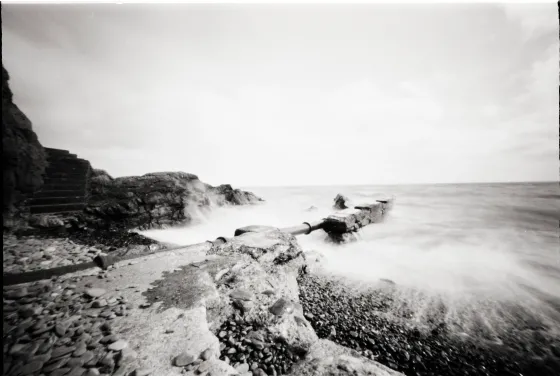
Self Pinterests // Homemade Pinhole // Ilford MG IV Rated at 6 ISO // Aperture:f172 // 15mins
Cuddles in the Kitchen // Homemade Pinhole // Ilford MG IV Rated at 6 ISO // f172 // 12mins
Book // Homemade Pinhole // Ilford MG IV Rated at 6 ISO // f172 // 180 mins
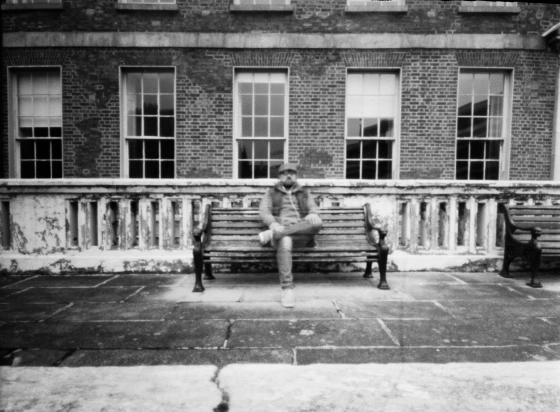
The Friary // Homemade Pinhole // Ilford MG IV Rated at 6 ISO // f172 // 34 mins
This is Poppy // Nikon F100 // Fujifilm Neopan 1600 // HC110 (B) 7.5 min 20c
At any time of year you can visit the Discover Ireland website and get a list of events that are taking place across the island of Ireland. For each month of the year there are lists as long as an average grown man’s arm trying to entice visitors to the country. Or if you are already here to try and get you to move around the island and spend your money. Mostly I look at what’s on listings to try and see if there is anything happening that I can make a point of missing. Then a couple of weeks later I can tell my wife it was on and say “We should’ve gone to that.”
I was very surprised this year when I looked at one of the more reliable listings and it only had one event noted for the whole month of March. This disturbed me because in the last few months I have seen my favorite coffee shop and book store close down due to the downturn. I have a real and genuine fear that the recession in this country will damage the arts and curb the progress that was made in the last decade. We have independent art galleries. The national gallery got new works and a face lift. We have a gallery of photography funded by the arts council of Ireland, a writers museum, signposted historical walks and so much more. But for the month of March listing after listing showed only one event. Saturday 17th March 2012 “St Patrick’s Day”
Saint Patrick or Patrick as he was originally know was born In Wales around 340AD. He was kidnapped by Irish raiders when he was 16 and taken to Ireland as a slave. He escaped six years later and returned home to became a priest. When he came back to Ireland as an ordained bishop he proceeded to spread Catholicism throughout the land. Stopping only briefly to rid the island of snakes unfortunately missing Leinster House which had yet to be built.
In the dioceses of Ireland Saint Patrick’s day is a holy day of obligation and also a Solemnity. This means it replaces Sunday as the most important day in the week for religious observances. I am sure at this stage you can sense why I was concerned. According to my listing this religious holiday was going to be my only source of entertainment for the month of March. So it was with a heavy heart and a general lack of enthusiasm that I ventured into our capital city to see what sort of celebrations the local authorities had decided were appropriate to honor someone that has been revered as the patron saint of Ireland since the 7th century. I brought my camera to document the solemnness of the day.
Wrap The Green Crowd Round Me // Nikon F100 // Portra 160
Wild Colonial Boy // Nikon F100 // Portra 160
Officially Friendly // Nikon F100 // Portra 160
The Kerry Recruit // Nikon F100 // Portra 160
Strongbow // Nikon F100 // Portra 160
Johnny Jump Up // Nikon F100 // Portra 160
Cathleen ni Houlihan // Nikon F100 // Portra 160
Beyond The Stage Door // Halina 160 // Neopan 400CN
Making our City Cleaner and Greener // Halina 160 // Neopan 400CN
Step 1. Go to the National Gallery of Ireland.
Step 2. Find the Still Life section – this is not a real section.
Step 3. Secretly snap a picture on the iPhone – generally frowned upon in the Gallery
Step 4. Visit a shop and stock up on fruit, rolls and silverware etc
Step 5. Convert the training room in your office into a mini studio
Step 6. Arrange fruit as per the iPhone Photo
Step 7. Take Photo
Step 8. Develop in the usual haphazard manor
Step 8. Post to the Internets.
I had a lot of fun doing this…
Still on a Roll // Nikon F100 // Kentmere 100 // HC-110 (G) 40min @ 20c
Onion by Request // Nikon F100 // Kentmere 400 // Adonal 1+100 Semi-Stand 90mins
Ketchup Recipe // Nikon F100 // Kentmere 100 // HC-110 (G) 40min
Still a Glass // Nikon F100 // Kentmere 100 // HC-110 (G) 40min
This blog-posting business is more difficult than I first assumed. I thought it would be just listing off the random stuff that floats through my head on a daily basis. It turns out that I am more void and less aware than I had hoped. It seems that quite a lot of my daily brain power is used sitting vacantly staring with my mouth slightly ajar. I am not a fan of self-help books but out of sheer desperation this week I visited my local library to investigate any literature that might help me shift my writers block and general inability to get things done. I had not been to a book depository since the JFK incident so was unsure of what to expect.
The air was filled with the musty but sweet smell of decay that I remember from my youth. The same haggard looking centenarian librarian was sitting behind the counter. His eyes locked on me the second I walked through the door and he winced as every plodding step echoed around the cavernous building. I cleared my throat to speak and in the quiet of the library it sounded like a gun shot. At this stage I was completely overwhelmed by the situation and gave serious consideration to turning on my heels and running for the door, but the man spoke first. It was one low and monotonous “Yeeessss?” I explained that I had not been in the library for a number of years and I was wondering if he could point me in the direction of the self-help books that might deal with my writers block. For once, I resisted the urge to explain about my blog.
I had never given much thought as to why we have libraries I just assumed that they were something in a community maintained for the benefit of all. As we inched our way down the aisles at a snails pace the keeper of books explained to me about Andrew Carnegie and his vision for public libraries – “industrious and ambitious; not those who need everything done for them, but those who, being most anxious and able to help themselves, deserve and will be benefited by help from others.” I took this to mean that the old man was impressed that I had the good sense to consider the public library as a place for education that would inspire me. This lofty opinion of myself was quickly destroyed when he handed me a stack of books and suggested that they seemed to be about on my level.
As I sit at my desk on a beautiful spring morning surrounded by books with titles like The Dummies Guide to Nose Breathing, The Idiots Guide to Chewing with your Mouth Closed and How to Sit in a Chair, I am saddened that my trip to the library has yielded no inspiration for a blog post.
Now where did I leave my camera…..
Centenarian Librarian F100 // Tri-X
I stumbled across this primitive dwelling while exploring the rain forests of North County Dublin. The hut appeared to be built in the classic style as described in the essays of Marc-Antoine Laugier and I think it may have dated back to the 4th century B.C.
I had hoped to meet one of the aboriginal people from that area but there was none to be found so I explored further, found a coffee shop and ordered an Americano and a slice of cake.
Camera:Nikon F401x
Film: Kodak TRI-X 400
Lens: Sigma 10-20mm F3.5 EX DC HSM
Dev: HC110 (B) 5min 20c
On the first official day of Spring we have been revisited by Winter. It got very cold very quickly. The heating is on and rain is lashing against the windows. There are weather warnings on the news about ice and snow.
The worst thing about winter in Ireland is that it starts to effect my life in October and seems to continue until at least May. How can this be, I can hear you yell at your computers? Ireland has a temperate maritime climate and we don’t have extremes of weather. It is never too hot and rarely too cold. It is easy to dress appropriately, eat well and stay comfortable regardless of the time of year. It is either rainy and mild or rainy and a bit cool.
This soft climate does not apply to my beautiful wife who manages to very quickly revert to her mantra of repeating every 15 seconds that she is literally freezing to death. I will continue to enjoy this statement from now until it switches to “I’m too hot” in June.
It has been a very long winter.
I have started to resemble a potato from a winter of sitting indoors, sipping stout and staring at books wearing nothing but a Snuggie. This is taking its toll on my creativity and I am delighted to see the first rising shoots of daffodils. In an effort to banish the last of the winter I am revisiting some of the spring days from last year. I am casting off the Snuggie potato skin and embracing the new season reborn as a beautiful butterfly.
Without winter there would be no time for quiet contemplation. Saturday lie-ins under the duvet surfing the internet or hours spent watching Twin Peaks to see if it does hold the answers to everything in the universe. Or Sunday evenings in a pub with an open fire and the Johnny Walker wisdom running high. Most importantly, without the darkness of winter we wouldn’t fully appreciate the amazing lightness of Spring.
“I’ve always been interested in doing that, but from what I can understand it can be quite costly.” When I read Kate’s comment, about my black and white film development, my initial instinct was that it is inexpensive and everyone should give it a try. But then it occurred to me that this may not be absolutely true. So with this in mind I reached for my protractor, slide rule and abacus to do some serious Maths. I can hear you all cry “Why not just use a calculator!” Well once you go analogue it is really very difficult to go back.
To try and keep this at least teetering on the edge of being interesting I’m going to do the very Irish thing of costing one item in terms of another unrelated and inexplicable item. This is similar to the system used to denote the tallness of something in relation to stacked double decker buses or how long something is compared to football fields. I will only occasionally give a direct price for something because everybody knows that it is rude to discuss money no matter how useful that information might be. I am not sure if this is unique to the Irish so let me know. I once bought a house and I still don’t know what it cost because I did not want to embarrass the estate agent by asking – true story!
If you are planning to develop film at home there is some essential equipment that you will need. I am not going into the specifics of how to develop film here because for the moment we are just interested in the cold hard facts of how much this will cost. The process of developing your own film is covered very well by other bloggers on the internets and my slipshod attitude to measuring and timing may only confuse if you are just starting out. The essential equipment required and associated costs are:
- Some form of measuring jug with markings on the side to indicate how much liquid is in the vessel. I bought mine in a €2 Shop. This is like a pound shop only slightly dearer for everything. I got three jugs for my two euros. The same two euros invested in my local corner shop could have bought me a large bag of popcorn and 330ml can of cola
- You will need storage bottles for your mixed chemicals. In the past I have reused water bottles for this – just make sure you label them with the chemical name and if you are of an artistic nature you can add a skull and cross bones so that you won’t drink them by accident.
- You will definitely need a film developer. My personal choice to-date has been Kodak HC-110. It comes in a concentrated syrup and seems to last forever. I use it as a one shot developer and I use about 6ml every time I develop a roll of 35mm film. I bought mine on-line and it cost €20.98 for a one litre bottle. Had I not bought the HC-110 my wife and I could have gone to see “Alvin and the Chipmunks – Chipwrecked” at our local cinema. This would cover the ticket price but the snacks would have to be funded from a non photography related opportunity cost.
- I bought stop bath when I was starting to develop my own film. It turns out that because of my preferred method of development I could have spared myself the €5.97 cost . Stop bath is not essential but can be handy. It is a pity I did not know this sooner because with that six euro I could have bought ten large loose oranges in my nearest supermarket and kept the scurvy at bay for a few more weeks.
- Fixer is key to film development. Once you have fixed your film you can expose it to the light. I have been using Ilfords rapid fixer. This also comes in a concentrated form and the working solution gets reused alot. I have developed somewhere in the region of 30 rolls so far and it is still working fine. A 500ml bottle cost me €8.59. The same money could have bought me a “Lack” side table in IKEA . It would have been easy to assemble, low weight and easy to move. It may not have lasted as long as my bottle of rapid fixer but at least I could have put a mug of coffee on it.
- You will need a thermometer. This is used to make sure that your chemicals are roughly 20 degrees centigrade. I picked mine up in the local pharmacy for €4.95. I went in to the pharmacy to get myself some bright orange fake-tan so in hind sight the thermometer may have been the better choice here.
- It would be very difficult to home process 35mm film without investing in a development tank and reels. Once again I bought mine from the internets. It cost me the handsome sum of €21.72 but I have seen these on eBay for less. I bought most of my gear from the one on-line shop to save on shipping. It costs €21 to rent a tennis court near me for one hours play. I do not play tennis but can we assume that this is because I wasted my money on photography equipment instead of getting out there and playing on the old clay court.
- The last essential thing is somewhere very, very dark. This is needed to transfer your film from the roll to the development tank. A windowless bathroom works best as it may be possible to seal it completely from any light sources. A changing bag would be a more practical option. This acts like a portable darkroom that you put your hands in to and work on the film. I mostly use a changing bag because I like to play guess the object and it also helps me avoid questions from my wife about what I have been doing in the bathroom for so long. My changing bag cost me the price of chicken wings, Thai beef salad and a cola in the Watermill pub. This is a local pub and my €19 euro would have gone further in the critical mass of the city centre.
Now for some fun Maths! I am going to try to work out the development cost per roll for the chemicals. I am sure this will be wrong so please feel free to leave the correct answers in the comments section below. Please remember that marks will be lost if you fail to show your workings. The total purchase cost of my chemicals was €35.54. I use 6ml of HC110 every time I develop a roll of 35mm film. I assume that my stop and fixer will be good for 40 rolls of film based on a Google search. That makes 49 cent the total chemical cost per roll. I am at a loss to think of anything I regularly buy that would cost 49cent.
My initial investment in equipment was €47.67 or thereabouts. Assuming that I can expect some wear and tear I plan to replace it in two years time if necessary. If I keep shooting and developing at my current rate I will burn through 104 rolls of film in that space of time. Hence the equipment cost per roll is 46 cent. This gives me a grand development cost of 95 cent. I now have a choice, I can develop a roll of 35mm film or enjoy a Snickers bar. Tough choice!
The price of the film you choose to shoot is probably the single biggest factor to consider because this will be the real ongoing cost for you. I currently enjoy the results that I get with Kentmere 400 film. This is a real stroke of luck because I can get this film for about €3.50 a roll if I buy it in packs of 10. There is cheaper film and there is frighteningly expensive film – pick one and try it.
This may not have been the most exciting blog post ever sent into cyberspace. There was less explosions than I had hoped for and I never quite figured out how to work in a love story. Luckily I did get to use my abacus for the first time in 700 years. More importantly it made me realize what needs to be sacrificed for my hobby. I think I can live with one less bag of popcorn and cola. I think the world is a better place if I never see Alvin and the Chipmunks. Fake tan on an Irishman is always a bad idea. One less meal in the Watermill every year is a small price to pay for the enjoyment that film development brings me. In total my hobby costs me less than a pint of Guinness in my local pub.
I can live without the Guinness but I may regret never learning how to play tennis.
What would you pay for this Hut – Nikon 401X 35mm Tri-X 400
What I Sacrifice for My Hobby – Nikon 401X 35mm Tri-X 400
No Disco – Nikon 401X 35mm Neopan 400
I had been to Los Molinos before, I remembered it as a beautiful rock of a place on the west coast of Fuerteventura. When you get there the next stop is the Atlantic ocean. You arrive on a winding and indeed windy road. The wind tears in from the Atlantic causing massive waves that have shaped the black and gray cliffs and produce beautiful booming noises at regular intervals. The sand on the tiny deserted beach is jet-black and when you stroll on it you can feel the burning heat rising through the souls of your feet. This is a place like no other.
People live here. There is evidence of life. A small Marian Shrine standing like a beacon staring out to sea, hoping and praying that the ocean will not claim the last fragments of the tiny village. There are houses. Worn by the sea, bleached white by the sun, paint peeling on the old timber doors. There are no locals to be seen. Maybe during my visit they were too sensible to be out in the afternoon sun.
The heat and the view were starting to get to me when I spotted a sign hand-painted in large letters on the side of a ramshackle building, “Las Bohemias Del Amor Cafe – Abierto” I like an adventure. So in the finest spirit of nothing ventured nothing gained we climbed the steps to see what was cooking.
Before we made it all the way in to what passed for the cafe we were met by a man who was dressed like a cross between a hippie and football coach. I used all the Spanish that I know to try and find out if the cafe was open. He looked through me and my wife for whole minutes before saying in a very loud voice “For you my friends we are open!” We asked for menus, he just laughed. We asked for coffee, he just laughed and wandered off.
He returned a few minutes later holding something that resembled a large fishing net. He motioned to me and I tried my best to understand what he was saying. I have a bit of a talent for languages. I have learned how to say “Can you repeat that a little slower?” in 12 languages and dialects. The problem I have is matching the words with the country I am in at that moment. Generally I try German in Italy, Spanish in France and Irish in Belgium. So like most native English speakers I revert to pointing and speaking English in a loud voice, until I give up or my adversary cracks and admits that they knew how to speak English all along. I knew instantly that this was no place for shouting. I shook my head and waved away the “fishing net.” My wife suggested that he wanted us to catch something in the ocean for lunch. I gave a little sigh of relief when he smiled, shrugged and turned away into the dark cave that we think was the kitchen.
On his return he had an arm full of kindling and a box of matches. It was only then did it occur to us just how remote this little cafe was, no running water, no electricity, no convenient multi-language menus with little flag pictures to let you know that you are reading it in your own native tongue. This man was lighting a fire to boil water to make us coffee. We were then left in the odd situation of sitting next to an open fire on a burning hot day. All the while our host was smiling and nodding at us.
Rather foolishly we had ordered our usual tipples of choice. Mine is normally a caffè Americano and my wife likes a caffè latte. These duly arrived but with a small twist. I received a black cup of coffee that I believe was made with salt water and the latte was made with condensed milk. I summoned all my extraordinary ability as a cunning linguist and some how managed to come up with ¿Es usted el seel helado? This made him laugh even harder as he dashed into his kitchen. He returned 20 minutes later with a very long explanation en Espanol and with something that was cold and had a flavor and texture that even if you gave me 100 years I could not describe. We wolfed it down and tipped back our coffees.
As we relaxed our host tiptoed off to climb into his hammock, which incidentally can resemble a fishing net when not hanging. I asked should we leave so that he could have his siesta. He indicated, verbally and through gestures, that he was not going to siesta but was going to meditate. That he was thinking, always thinking “Spiritual.” I fear that he too had been at the ice cream and salt water.
There was something special about that beautiful place, that man, the whole afternoon. If I could only have one memory that lasts I would like it to be this one………

I don’t tend to relax when I’m on holiday. I enjoy catching up on reading and I go a bit overboard with the photography because I have spare time, but I don’t lie on a beach working on my tan. This does not mean that I don’t enjoy holidays it just means that I have an odd need to be doing something. Having secured our Panda a couple of days earlier it was time to hit the open road and enjoy the sights and sounds of all that the Island of Fuerteventura has to offer. There was culture to be found and I wanted my fill.
When I was packing my suitcase I had a little choice. I could bring three more rolls of Kentmere 100 film or my Sat Nav. Me being me – I chose the film. We had been to the island a couple of times before so I had a good idea of how to get around and because we were staying in the north east corner of the Island I knew that every time I hit the sea I could just turn around and head the opposite direction and I would find my way home Lassie style.
On our first visit to the island a few years ago we stumbled upon a coffee shop/museum on top of what I now suspect is the highest point on the Island. It is a great vantage point and you can see to the ocean on both sides of the island from the top of the mountain. The vista is indeed buena. Now that in polite company I actually refer to myself as an amateur photographer it seemed like a good destination for a “photo-shoot”. I remember thinking last time that it was a pleasant drive and a great view – the perfect counterpoint to another day sipping coffee waiting for the sun to rise above the yardarm to indicate that it is “Mojito o’clock”
It all started out so well. We could see the mountains in the distance and I believed that I could even make out a small outcrop of rock that housed the coffee shop of my memories. I had a nagging feeling that I should have taken a right turn but doubted myself so went straight. This brought us onto a very narrow and very bendy road. As the panic started to take hold I gave in and asked my wife to have a look at the roadmap in the glove box.
My wife opened the glove box, there was a loud click and the radio came on full blast, it was some Spanish talk radio where the host just shouted and increased and decreased the volume of the background music to punctuate what he was saying but I could not make the noise stop. I turned off the radio. All the lights on the dash went out but still the radio blasted. I could not stop because the road was so narrow and windy that it was not safe. I was shouting at my wife to try and figure out where we were and she was just babbling and screaming something about Aloe Vera. My immediate reaction is that the whole thing had been too much for her and that her mind had snapped.
I was really starting to worry. The noise of the radio was effecting my ability to keep the car on the narrow road. I couldn’t concentrate – it seamed that every time I turned the wheel to the left or reduced my speed the radio got louder. I could feel the front of the car slide on the camber of the roadway. When I dared look to my left or right it appeared that we were driving on a knife edge with a 200 meter shear drop each side.
I was pleading with my wife to let me know where the road might end and she continued to mumble about Aloe Vera. If only I could stop the car I could think, read the map and figure out how to get us off the god forsaken mountain. We rounded a hair pin bend and were confronted with the odd spectacle of a tour group in a car park taking pictures of tiny little rat type creatures. I jammed on the breaks and killed the engine. The sense of relief that passed through my body when the radio stopped is a feeling that I will never forget.
My wife turned to me and asked was I glad I brought the extra rolls of film instead of my Sat Nav and handed me the Map – it showed no towns, no cities and had just enough road detail to be called a map. It did however have an incredible amount of detail on where to find the six locations on the Island where you could watch Aloe Vera being pressed and sold fresh. We had no idea of where we were since my wife had her eyes closed for half the journey and the radio had destroyed my short term memory.
We did eventually make it off the mountain but that is another story…..and for the record – the road map was an optional extra from the car hire company that cost me €25.
Our Saviours on the Mountain – F100 35mm – Etkar 100
Rat Based Tourist Attraction – They will eat your nuts! F100 35mm Kentmere 100
I just made an interesting discovery. Developing my own film has brought me one step closer to understanding the Grand Unifying Theory. I have two great passions in life Photography and Quantum Mechanics. One part of the previous sentence is a lie. Can you tell which part?
I own and happily use a digital camera but at the moment I have a preference for film photography. However I am grateful for what I learned using a digital camera. It gave me a very clear understanding of what the aperture and shutter does and how controlling these aids creativity. The instant feedback from the LCD screen allowed me to recompose and shoot again before moving on. It trained and educated me. But things are different now.
My photography work-flow has changed dramatically in the last eight months. I now guess at the required exposure settings, sometimes aided by my meter or sometimes I think my meter lies to me. I will occasionally bracket a shot to reduce the risk but the real fun is in never being sure of what I will get.
Schrödinger put his cat in a box with poison. Under certain conditions the poison would be released. In theory the cat in the box would be both alive and dead because he is not being observed. Schrödinger’s cat is used to illustrate the difficulties with the Copenhagen interpretation of quantum mechanics. I have a similar problem that I call the interpretation of DIY shot and developed film. You put the film in your camera shoot it and then try and develop it. While the film is in the camera or tank you can convince yourself that all the shots are both fantastic and rubbish at the same time. Your film remains in this quantum flux until they are observed.
I think this is why every time I lose or destroy a roll of film I am able to believe that it contained my best ever photos….
A walk in the woods – Nikon F100 // Fujifilm Neopan 1600